Showing posts with label WWII. Show all posts

Monday, April 25, 2016

The Lessons of Cemeteries


On our last day in Normandy, we visited the Normandy American Cemetery and Memorial, where 9,387 of our servicemen and women are buried. Another 1,557 are listed on the Walls of the Missing.


Most of these soldiers gave their lives in the D-Day invasion and subsequent battles.


Including Thomas J. Sullivan above. This was the first grave I happened to look at. Pvt. Sullivan would have been in the first wave of the Utah Beach landing.


The cemetery is located on a bluff overlooking Omaha Beach, the D-day site where so many American soldiers lost their lives. 


We saw the grave of Theodore F. Rosenbaum. He was a 2nd Lt, in the 358th Regiment of the 90th Division, John's dad's Regiment. Lt. Rosenbaum was awarded the Bronze Star and the Purple Heart.


In one of John's dad's (John) letters, he says that his best friend in the Army was killed. He didn't describe the circumstances or give his friend's name (he couldn't reveal that information). But a few years ago, we found the below letter in John's papers and figure there's a good chance this is his friend.


The Normandy Visitors Center has computer terminals where you can look up any person buried in a military cemetery. 


Staff Sgt. Kvenmoen is buried in Epinal, in the northeast part of France. 


We will hope to pay our respects on another trip.


Brig. Gen. Theodore Roosevelt Jr., son of President Teddy Roosevelt, fought heroically in World War I and II. He helped coordinate the D-Day invasion and then asked to accompany his men, even though he needed a cane to walk because of his WWI injury and he was 56. At first, his commanding officers said no, but he persisted. After Roosevelt and his men were blown a mile off course of their Utah Beach landing target due to strong currents, he reassessed the situation and said, "We'll start the war from right here." Roosevelt was the only general in the first wave on D-Day. He raised the men's morale through his presence and good humor, telling stories of his father and reciting poetry during the invasion. Roosevelt died in Normandy about a month later of a heart attack. 

When 5-star General Omar Bradley was asked to name the most heroic act of the war, he said, "Theodore Roosevelt on Utah Beach." Roosevelt's son Quentin was part of the invasion on Omaha Beach. They are the only father and son who took part in the D-Day invasion. Roosevelt is buried next to his brother, also named Quentin, who was killed in WWI.


When we were leaving Orglandes a couple of days ago, where John's dad's regiment was, we passed a high wall. We stopped to see what was on the other side of the wall. 


It was a German war cemetery. 


There are over 10,000 German soldiers buried here. This cemetery contains more graves than Normandy.


But there are far fewer headstones as sometimes six names would be on each stone, three on each side.


We wonder about the men buried here. Some were probably committed Nazis. Others, unwilling German conscripts. Like all of us, children of God.


There are so many things to think about, so many lessons from visiting these places.


Above is a memorial on the wall of the Bayeux cathedral, memorializing the French who died in concentration camps. I wonder what the dead would say to us. Maybe things we already know.


At the Normandy Visitors Center, the narrator of a film described the stakes of the D-Day invasion:
"The fate of the free world--the entire free world--rested on their very young shoulders."


Saturday, April 23, 2016

Miracles and Succor at Normandy Churches

While we were looking for the towns that John's dad mentioned being in, we went to other towns where his division, the 90th, may also have passed through. Each town had a church with its own story.


In the above church at Angloville-au-Plaine, just a short drive from Utah Beach, two American medics treated U.S. and German soldiers, while the war went on around them. When German soldiers entered the church, the medics--Kenneth Moore and Robert Wright--insisted that they leave their guns outside and they complied.


They saved several lives. The evidence of the wounded is pictured above. Blood stains remain on the pews.


The contradictions of war are hard to get one's mind around: outside the church, Americans and Germans were killing each other and inside the church American medics were saving both. 

Church at Ste-Mere Eglise
We visited Ste-Mere Eglise, one of the first towns to be liberated by Americans after D-Day. Prior to the landing on June 6, U.S paratroopers were dropped over the area to support the invasion. Due to bad weather, many of the paratroopers were blown off course were killed by the Germans. The parachute of one of the soldiers, John Steele, became snagged on the church steeple, leaving him dangling there for hours. If you look closely at the photo above, you can see a facsimile of the soldier and his parachute. Pvt. Steele was captured by the Germans, but later escaped and survived the war.


Not far from Utah Beach is Ste.-Marie du Mont, another town with a church that was liberated by the Americans. A sign outside the church tells of some American and German soldiers who came face to face and decided not to fire. Other Germans hid in the church and were discovered in the Confessional.

Church at Ste Marie-du-Mont
Above, the first Mass held after the town was liberated.

Church at Ste. Marie du Mont

Friday, April 22, 2016

In the Footsteps of John's Dad


Jour J, they call it in France: we know it as D-Day. It was the largest military operation in history, part of the largest event in human history, World War II. On these beaches, in June 1944 the Allied forces invaded German-held France and in less than a year, the Nazi regime would be over.


We have come to Utah Beach because John's dad, John Carroll, landed here with the 358th Regiment of the 90th Infantry Division of the U.S. Army almost 72 years ago. We are planning to retrace some of his steps in the area.

We know where he was because we have some of his letters. John's cousin Mary Cosgrove wrote him faithfully during the war and he wrote back when he could. His cousin later gave about 30 letters to John's mom and a few years ago, we found them in the house. Here is an excerpt of a letter.


This letter was written well after the events they describe. Soldiers had to be careful what they wrote about and could not include their location or other identifying information. Look what happened if they did. 

It's almost as if John knew the letter would be censored.
John, like so many millions of other men, were ripped from their wonderfully ordinary lives because of a couple of murderous madmen (and their followers) who wanted to take over the world. For him, World War II started at Utah Beach in the Normandy region of France.


We spent time wandering this beach, trying to imagine what it must have been like to approach the shore from some kind of landing craft, not knowing what to expect.


The loss of life at Utah Beach was not nearly as great as that at Omaha to the south, in part because it was not as well fortified by the Germans. There were still some defenses, though.

Luke standing on top of a German bunker.
This didn't stop the troops.


We had lunch on the beach at The Roosevelt Memorial Bar, named after Brigadier General Teddy Roosevelt, Jr, son of President Theodore Roosevelt,  and one of the heroes of D-Day. 


After lunch, a French man in his sixties came up to me and asked if I was American. When I said that I was, he extended his hand and said, "Thank you very much." I told him my father-in-law had been part of the D-Day invasion. We had read that the French in this area continue to be very grateful to the Americans for liberating France.


Afterwards, we went to the excellent museum at the beach. In the museum, we learned about the French resistance and how respectful the French were of the American soldiers both in life and death. 


We also learned that the Utah Beach landing site was added at the last minute. It turned out to be a very fortuitous addition. More than 800,000 American troops and tons of equipment would later land at Utah Beach.


Including 40,000 men of the 90th Division, the Fighting 'Ombres.


John stands in front of the 90th Infantry Division Memorial, pointing to the plaque listing the regiments, including his dad's 358th. Out of 40,000 men, 3,340 are killed and 18,051 wounded in the European Theatre.


We leave Utah Beach to find a couple of towns John's dad mentioned in his letter: Chef du Pont and Orglandes. Chef du Pont is not on the map above, but it is between Sainte-Mere Eglise and Pont L'Abbe, both places the 90th Division also passed through. We also know the Division's movements from an online history on the 90th's fighting in France.


As we pass through the gently rolling French countryside of Normandy, it's hard to envision this now peaceful land as war torn and occupied.


Above are the infamous hedgerows that Allied intelligence didn't take into account. This territory was easier to defend than take.


We arrived in Chef du Point, where John said his regiment first contacted the enemy. We went to the church because we felt that this would have been a place John would have gone to in the town, if he'd had a chance. We wandered around the grounds a bit, not a soul in sight. Many of the small French towns seem almost deserted, despite the presence of businesses and homes. As we walked, the bells of the church began to ring and the man below materialized.


His name is Aubrey Martin, and he had the keys to the church. He let us in.


We said some prayers in the beautiful church. Most of the churches we've been seeing in the French countryside are of the simple Romanesque-style, unlike the Gothic cathedrals in France.


Aubrey is 93 years old, only six years younger than John would be if he were alive. He was 22 during the D-Day invasion and away at school, but his family remembers the American soldiers.


A sign on the side of a building in Chef du Pont: Liberation Street.


We bid adieu to Chef du Pont and traveled on to Orglandes.


It was in Orglandes that John said he he got his "first baptism of fire in quantity."


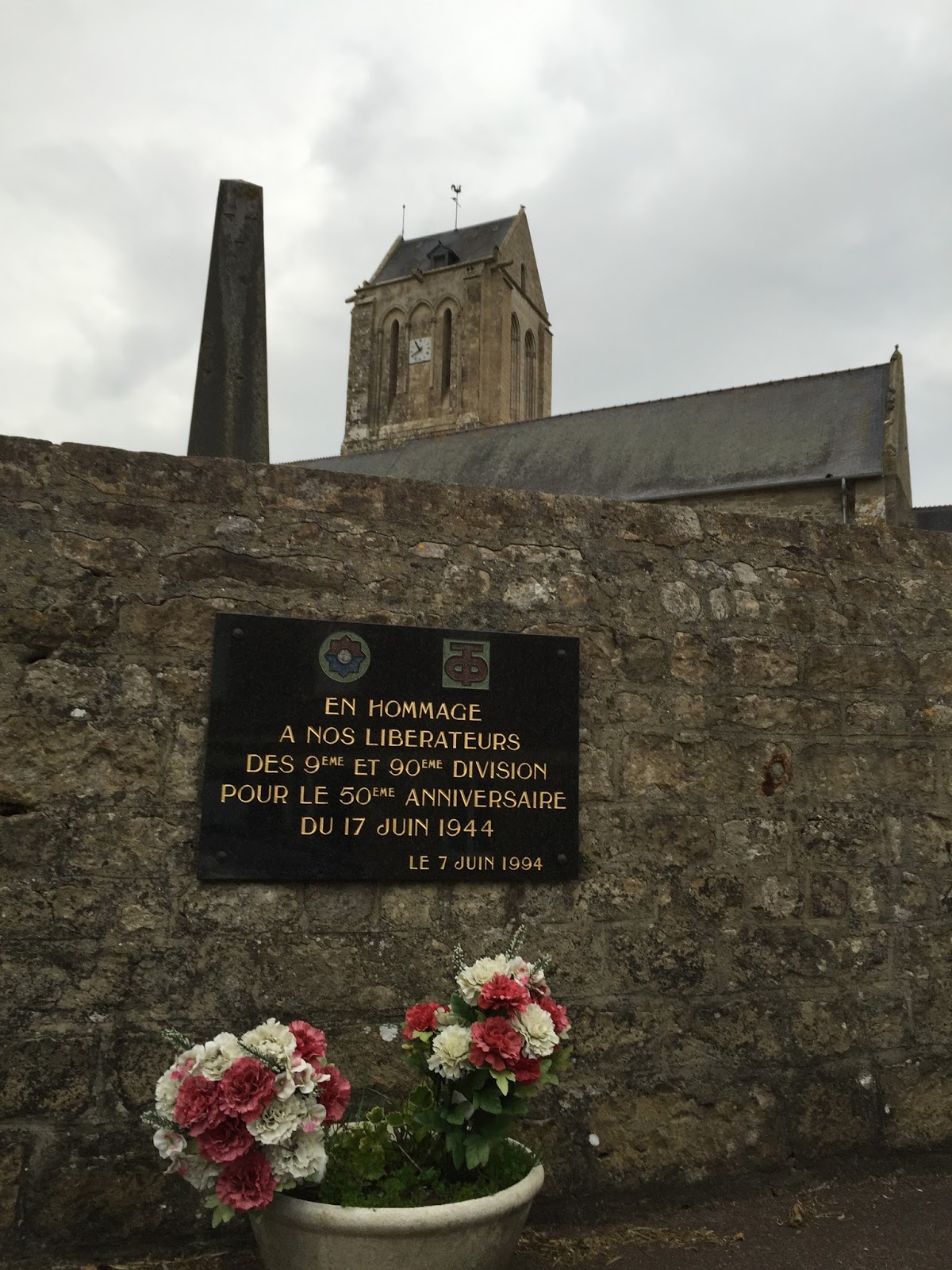
This house would have been there when John's regiment passed through. We headed for the church. Once again the church bells started to ring and look what we found.


The plaque above reads: In honor of our liberators, the 9th and 90th Divisions on the 50th Anniversary of the June 17, 1944 liberation.

The 90th pushed through France and on into Germany, where they liberated the Flossenberg concentration camp. John would remain with the 90th in Europe until November 1945, several months after the war was over. 

In the Utah Beach museum we learned that the 90th Division's "lack of combat experience, inadequate training, and command issues" led to heavy losses in early battles in France. But the boys learned quickly. They begin fighting and winning difficult battles and by the end of the war the 90th is considered one of the best infantry divisions in Europe.

In his letters, John continually minimizes his own contributions to the fighting. Later on, like many WWII veterans, he didn't talk about his experiences. John didn't know his father was awarded the Bronze Star for valor until a few years ago when we found it in the house.